
Licensed in Louisiana, Texas, and Arkansas
Licensed in Louisiana, Texas, and Arkansas

When a loaded logging truck loses its brakes on a grade, sheds a wheel on a parish road, or breaks loose from its trailer, it can look like bad luck. Truck parts do not fail in isolation, though. Every component on a working truck was built by someone, installed by someone, and was supposed to be inspected and maintained by someone.
That chain of hands is what separates an equipment failure claim from a crash caused by a single driver’s mistake. The question is not only who was behind the wheel, but who was responsible for the part that failed, and when it stopped being safe.
At Lukov Injury Law, we look at the failed component before anything else, because the part itself and the paper trail behind it are what can show where the failure began.
Below, we cover the parties who may answer for an equipment failure under Louisiana and federal law, how fault can be divided among them, and what evidence connects a broken part to a responsible party. Contact us today to talk through your crash and where the failed part is now.
An equipment failure is a breakdown in a part or system the truck needed to operate safely. The federal maintenance rule for commercial motor vehicles, 49 CFR 396.3(a), requires parts and accessories to be kept “in safe and proper operating condition at all times”, and it names the frame, suspension, axles, wheels and rims, and steering among them. On a logging rig, the systems that come up in a failure claim include:
The stakes, bunks and tiedowns that hold the logs in place are a separate subject, with their own federal rules, and our article on why logging truck accidents are more dangerous covers them in detail.
A failure is also different from a cause. A tire can fail because it was built with a flaw, because it was worn past safe use, because it was mounted or repaired incorrectly, or because it was carrying more than it was rated for. Each of those explanations points to a different party, which is why identifying the cause is the first step in any logging truck crash claim that involves a broken part.
When the truck is a commercial motor vehicle, federal regulations place a maintenance duty on the motor carrier.
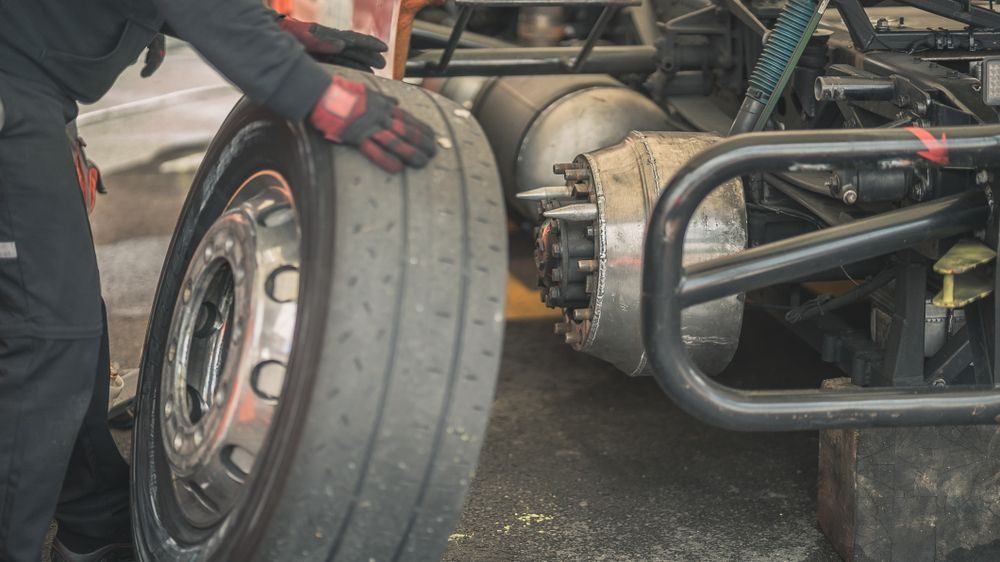 Under 49 CFR 396.3(a), every motor carrier must “systematically inspect, repair, and maintain” the vehicles subject to its control. The word systematically describes a program that runs before anything breaks, not a repair made after a part fails.
The same subsection requires parts and accessories to be kept “in safe and proper operating condition at all times.” That standard describes the condition the vehicle was supposed to be in on the day of the crash, not only on inspection day.
The phrase “subject to its control” carries weight in logging, where the tractor, the trailer and the business hauling the timber may not all belong to the same entity. Who controlled the vehicle is answered by documents such as leases, contracts, registration and operating authority, and that answer identifies whose maintenance program is under review.
Under 49 CFR 396.17(a), every commercial motor vehicle must be periodically inspected, and each vehicle in a combination is inspected separately. For a logging rig, that means the tractor and the trailer each carry their own inspection. A trailer component is not accounted for simply because the tractor passed.
These rules do not make a carrier responsible for every failure. They set a standard against which the carrier’s conduct can be measured, and whether a gap between the rule and the practice caused the crash is a question for the physical evidence. How long the maintenance file must be kept is covered in our article on federal trucking regulations.
A truck driver in Louisiana is liable for damage when the driver’s own fault caused it, and an equipment failure does not change that test. La. C.C. art. 2315(A) provides: “Every act whatever of man that causes damage to another obliges him by whose fault it happened to repair it.”
The key words are “by whose fault.” A driver does not become responsible simply because a part failed while the driver was at the wheel. The question is whether the driver’s own conduct contributed to the crash, and that is a question of fact.
Evidence may show that the driver noticed warning signs, such as a pull in the steering or a grinding sound, and kept driving. Or it may show a sudden failure the driver had no reason to see coming.
What the driver felt, heard or saw before the failure is evidence too, because it can help fix when the part began to fail.
The relationship between the driver and the trucking company, including when an employer answers for its driver and when a claim runs directly against the carrier, is covered in our article on suing trucking companies and individual drivers. Those questions arise in any 18-wheeler crash claim, and an equipment failure case adds the parties who built and maintained the part.
Louisiana has a specific statute for claims against manufacturers. La. R.S. 9:2800.54(A) provides: “The manufacturer of a product shall be liable to a claimant for damage proximately caused by a characteristic of the product that renders the product unreasonably dangerous when such damage arose from a reasonably anticipated use of the product by the claimant or another person or entity.”
For a brake component or a wheel assembly, the use at issue would be service on a working truck, and whether that use was reasonably anticipated is part of the claim.
Under La. R.S. 9:2800.54(B), a product is unreasonably dangerous “if and only if” it falls into one of four categories, each with its own section:
Under La. R.S. 9:2800.54(C), the characteristic that made the product unreasonably dangerous must have existed when the product left the manufacturer’s control, and for design and warning claims, the rule also reaches a reasonably anticipated alteration of the product. Under subsection (D), the claimant carries the burden of proof.
Those two provisions explain why the failed part matters. If the evidence shows the part left the factory sound and later failed from wear, damage or an improper repair, the explanation may point away from the manufacturer and toward whoever was responsible for maintaining it. If it shows a flaw present from the start, the manufacturer comes into the picture.
Yes. Louisiana’s comparative fault article, La. C.C. art. 2323, provides that the fault of all persons is quantified, whether or not each person is a party to the case. An equipment failure is the kind of crash where several shares can exist at once.
A wheel that separates from a loaded trailer may involve a flaw in the part, a maintenance program that missed the wear, and a driver who ignored a vibration. The parties who may carry a share include:
The injured person’s own conduct is part of the same assessment. Under art. 2323, when the injured person’s share is below the threshold the article sets, “the amount of damages recoverable shall be reduced in proportion to the degree or percentage of negligence attributable to the person suffering the injury, death, or loss.” A share at or above that threshold bars recovery. That version of the article took effect on January 1, 2026, so for an earlier crash the version that applies should be confirmed with a lawyer.
Because a nonparty’s fault is quantified too, leaving a responsible party out of the investigation does not make that share disappear.
An equipment failure claim is built on physical evidence and the records that explain it. The pieces that show where a failure began include:
The failed part is the piece at greatest risk. After a crash, a damaged truck may be repaired, sold or scrapped, and the component can be discarded with it. A written request to preserve the vehicle and the part, sent early, protects the evidence a claimant needs to c
