Licensed in Louisiana, Texas, and Arkansas
Licensed in Louisiana, Texas, and Arkansas


Commercial trucks operate under federal rules that do not apply to ordinary passenger vehicles, covering how long a driver may stay behind the wheel, how the inspection cycle works, and how long the carrier keeps the records that prove both. Those rules sit in Title 49 of the Code of Federal Regulations, and a violation of one of them can become the center of an injury claim. The records that establish a violation also have expiration dates, the shortest running three months.
A record of duty status and a periodic inspection report are unfamiliar documents to anyone outside the trucking industry. In a truck claim, they can carry more weight than what was visible at the scene.
At Lukov Injury Law, we build Louisiana truck claims around the federal record trail, because that is where the provable facts live.
The federal rules that bear on a Louisiana truck crash are set out below, with how long the supporting records survive. Contact us today to talk through what happened and what records may still exist.
The Federal Motor Carrier Safety Regulations apply to most interstate commercial motor vehicles, which covers the tractor-trailers running Louisiana’s freight corridors. They bind both the driver and the motor carrier that employs them, and they create paperwork at nearly every step.
Four areas generate records that bear on an injury claim, and each has its own rule and its own retention period:
A claim does not depend on finding a single violation. The records either corroborate the driver’s account or contradict it, and a contradiction is what gives a claim somewhere to go.
Fatigue rules sit at the center of the federal scheme, and 49 CFR 395.3 sets three separate limits.
A property-carrying driver may not drive without first taking 10 consecutive hours off duty.
Once the driver comes on duty, a 14-consecutive-hour window opens, and driving is not permitted after that window closes. During that window, the driver may accumulate up to 11 hours of actual driving time.
 Driving is not permitted once more than 8 hours of driving time have passed without at least a consecutive 30-minute interruption in driving status. That interruption can be satisfied by any of the following:
Short-haul drivers who qualify under 395.1(e)(1) or (2) are excepted.
Weekly limits run alongside the daily ones:
Either period may be reset by an off-duty stretch of 34 or more consecutive hours.
Those numbers are the ceiling, not guidance, and exceeding them is a violation whether or not the driver felt tired.
Hours-of-service rules would be unenforceable without records. The record of duty status, with its supporting documents, shows whether a driver stayed inside the limits on the day of a crash.
Retention is where the timing pressure comes from. Under 49 CFR 395.8(k)(1), a motor carrier “shall retain records of duty status and supporting documents” for each of its drivers “for a period of not less than 6 months from the date of receipt.”
The driver carries a shorter window. The same rule requires the driver to keep a copy of each record of duty status for the previous 7 consecutive days in their possession and available for inspection while on duty.
Six months is the floor. Once it passes, a carrier may lawfully dispose of the records that would have shown what the driver was doing in the hours before the collision.
Mechanical condition is the second record stream. Under 49 CFR 396.3(a), every motor carrier “must systematically inspect, repair, and maintain, or cause to be systematically inspected, repaired, and maintained,” all motor vehicles subject to its control, with parts and accessories kept in safe and proper operating condition at all times.
 The rule also requires records. For each vehicle the carrier controls for 30 consecutive days, the file has to hold:
Retention runs on two clocks. Under 396.3(c), those records must be kept where the vehicle is housed or maintained for 1 year, and for 6 months after the vehicle leaves the carrier’s control.
Separately, 49 CFR 396.17 requires that every commercial motor vehicle pass a periodic inspection at least once during the preceding 12 months, with documentation carried on the vehicle.
The maintenance rule in 396.3 was itself amended as recently as July 2026, a reminder that federal trucking rules can shift within a single rulemaking cycle.
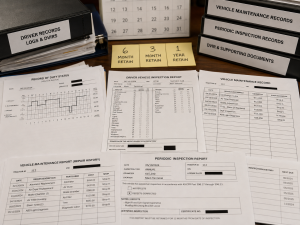
The regulations set the outer limit on how long each of these survives. The shortest is the driver vehicle inspection report, which a carrier keeps for three months from the date the report was prepared under 49 CFR 396.11.
Louisiana sets a two-year prescriptive period for most personal injury claims, running from the day the injury is sustained. That is considerably longer than the retention periods above, which is the practical problem.
A claim filed inside the legal deadline can still arrive after the records that would have supported it were lawfully discarded. Nothing about the filing deadline extends a carrier’s retention obligation.
It is worth being precise here. A written request does not by itself obligate a carrier in Louisiana to hold on to anything, so the realistic protection is time rather than paperwork.
Fault percentages add a second reason to establish the federal record early. Under Civil Code article 2323 as amended by Act 15 of 2025, effective January 1, 2026, a person found 51 percent or more at fault recovers nothing, and a lower share reduces the award proportionally, so documented regulatory violations can shift where that line falls.
The federal record trail is what decides most of a Louisiana 18-wheeler crash claim, which is why the retention dates matter more than they first appear.
The federal rules help an injured person only while the records that prove a violation still exist. At Lukov Injury Law, we go after the record trail first, because the six-month retention floor in 49 CFR 395.8(k)(1) starts running from the day the carrier receives the record.
Abby Lukov works these files directly from our New Orleans office, and the first conversation costs nothing. Call us today at 504-315-5056 to talk through your crash and what records may still be recoverable.
Disclaimer: This article provides general information and should not be treated as legal advice. Laws change over time, and outcomes depend on the specific facts of each case. No attorney-client relationship is created by reading this article or contacting Lukov Injury Law LLC. For advice about your situation, contact a qualified attorney. Time limits apply to legal claims, so do not delay in seeking legal help.
Under 49 CFR 395.3, a property-carrying driver may drive up to 11 hours, and only within a 14-consecutive-hour window that opens when the driver comes on duty. The driver has to take 10 consecutive hours off duty before that window begins.
Driving is not permitted once more than 8 hours of driving time have passed without at least a consecutive 30-minute interruption in driving status. That interruption can be off-duty time, sleeper berth time, on-duty time that is not driving, or a combination. Drivers who qualify for the short-haul exceptions in 395.1(e)(1) or (2) are excepted.
Under 49 CFR 395.8(k)(1), a motor carrier “shall retain records of duty status and supporting documents” for each of its drivers “for a period of not less than 6 months from the date of receipt.” The driver separately keeps the previous 7 consecutive days of records in their possession while on duty.
The driver vehicle inspection report. Under 49 CFR 396.11 it is kept three months from the date the report was prepared, which is shorter than the six-month floor for duty-status records under 395.8(k)(1) and shorter than the maintenance file under 396.3(c).
Under 49 CFR 396.17, every commercial motor vehicle has to pass a periodic inspection at least once during the preceding 12 months, and documentation of that inspection is carried on the vehicle.
No. A regulatory violation is evidence that can support a negligence claim, but liability still depends on proving that the violation caused the crash and the resulting injuries. Fault is assessed on the full record, and Louisiana divides it by percentage between the parties.
A request can be made, but it is worth understanding its limits. In Louisiana, a written request alone does not obligate a carrier to preserve anything, which is why the practical answer is to act while the federal retention periods are still running rather than to rely on the request itself.
No. The federal retention periods run on their own schedules and are not affected by how long a person has to file. Louisiana allows two years for most personal injury claims while the shortest federal floor is three months, so the two clocks move independently.