Licensed in Louisiana, Texas, and Arkansas
Licensed in Louisiana, Texas, and Arkansas

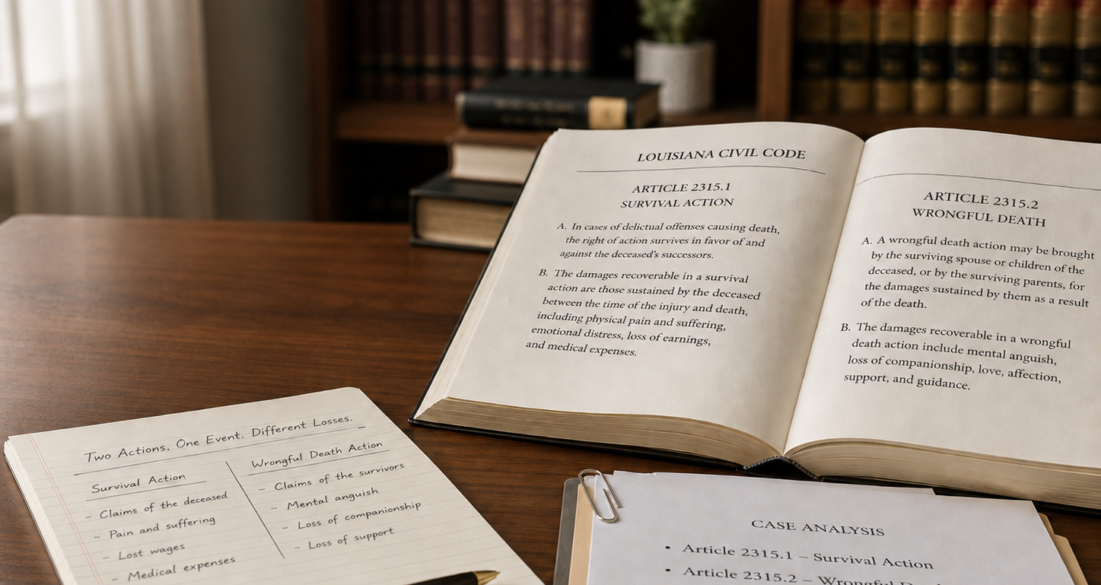
In Louisiana, a wrongful death claim and a survival action are two separate claims that can follow a fatal accident. The wrongful death claim repays the surviving family for their own losses, like lost support and companionship. The survival action repays what the deceased personally went through before death, like pain and medical bills. The same family members usually file both, under Civil Code Articles 2315.2 and 2315.1.
After a fatal accident, families often hear two legal terms used in the same breath and assume they mean the same thing. Wrongful death and survival actions are related, but they recover different losses and answer different questions.
Understanding the split helps a family make sure nothing they are owed gets left out of the case. At My Lawyer Abby, the personal injury practice of Lukov Injury Law LLC, we help families across New Orleans pursue both claims under Louisiana law when the facts support them.
This guide explains what each claim is, how they differ, and why they usually move forward together. Contact us today to ask which claims fit your family’s situation.
A wrongful death claim belongs to the surviving family, not to the person who died. It is built on Louisiana Civil Code Article 2315.2, which lets certain relatives recover for the losses the death causes them.
These losses include lost financial support, lost love and companionship, lost household services, and grief. The claim looks forward at what life is like for the family now that their relative is gone.
Only a set group of relatives may file, in a fixed order: first a surviving spouse and children, then parents, then siblings, then grandparents. A higher class excludes the ones below it.
If no one in the first class survives, the right to file moves down to the next class, so a parent may hold the claim when there is no spouse or child. This tiered structure can matter in blended families or estranged relationships, where the person closest to the deceased may not be the one the statute places first.
The claim does not cover what the deceased personally felt before death, which is a common point of confusion. That separate harm belongs to the survival action, which is why the two are usually filed side by side.
 A survival action stands in the shoes of the person who died. Under Civil Code Article 2315.1, it recovers the claim the deceased could have brought if they had lived.
This means the damages the person felt between the injury and death, such as physical pain, mental anguish, medical bills, and lost wages during that time. The action looks backward at what the person went through, not at the family’s future.
The same beneficiary classes that file the wrongful death claim also bring the survival action. Because the survival action belongs to the deceased, the money it recovers is handled through their succession, which is the Louisiana term for an estate. From there it reaches the same relatives who hold the wrongful death claim, so the two recoveries often land with the same family.
How long the person survived after the injury often shapes the value of a survival action. A death that follows hours or days of conscious pain supports a larger recovery for that suffering than a death that is immediate, which is one reason medical records and witness accounts from those final hours carry weight in these cases.
The clearest difference is whose loss is being paid for. A wrongful death claim repays the family’s own losses, while a survival action repays the losses the deceased personally suffered.
Picture a fatal crash where the person lived for two days in the hospital. The survival action covers what that person endured in those two days, and the wrongful death claim covers what the family loses going forward.
That difference is why a single accident can support two recoveries without paying for the same loss twice. One claim answers what the person went through, and the other answers what the family is left with.
It also explains why the value of each claim can move in different directions. A death that was instant may carry a small survival claim but a large wrongful death claim, while a long, painful decline can flip that balance.
The two claims cover different categories of damages, which is why they are not duplicates. The wrongful death claim handles forward-looking family losses, and the survival action handles the deceased’s own pre-death harm.
Keeping the categories separate keeps the full value of the case visible. We make sure each loss is placed in the claim where it belongs so nothing is double-counted or missed.
On the wrongful death side, that means support, companionship, services, grief, and funeral costs. On the survival side, it means the pain, medical bills, and lost wages that built up before the person died.
Each category needs its own kind of proof, from pay records for lost support to hospital charts for pre-death pain. We match the evidence to the claim so neither side of the case is left thin.
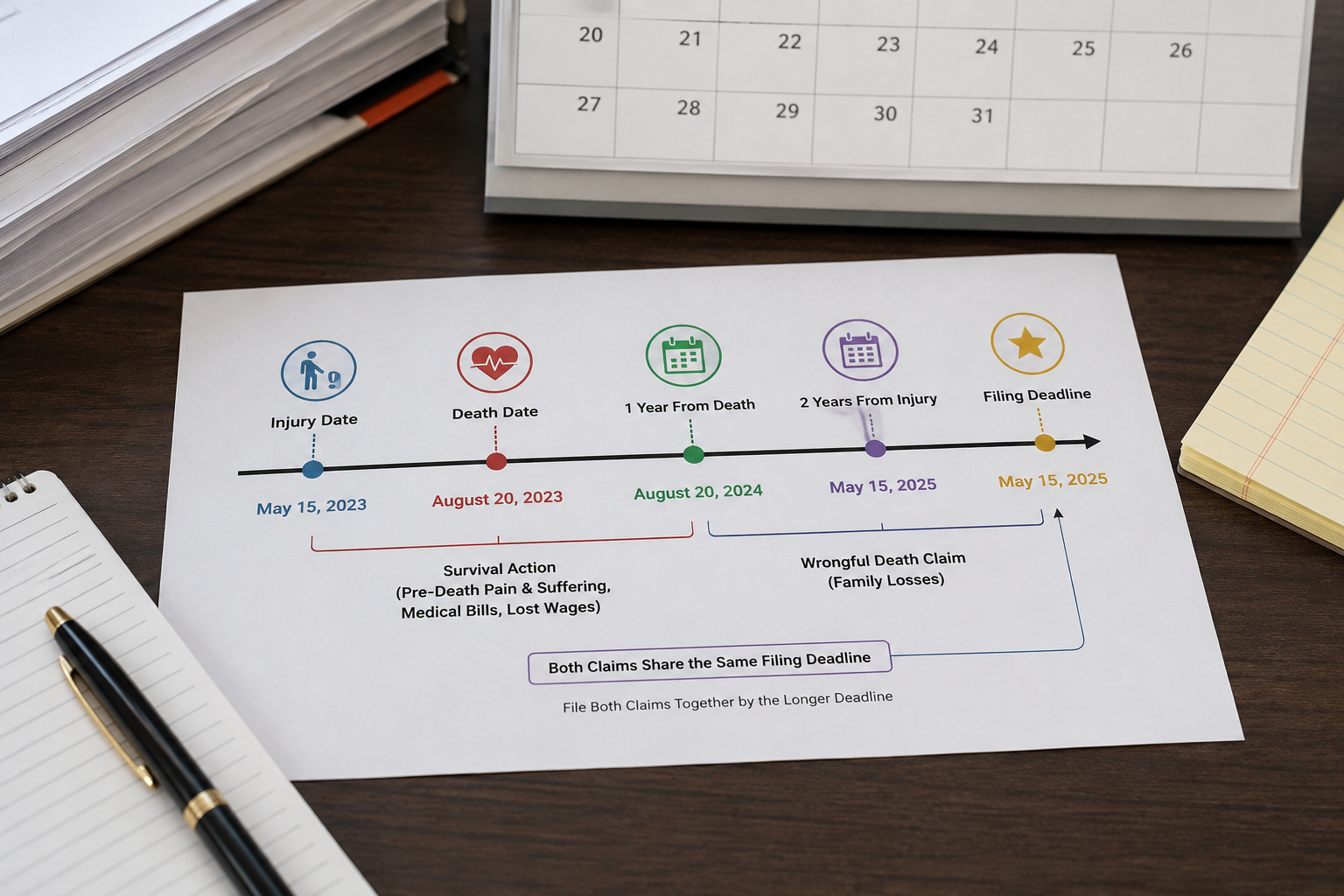 Both claims now share the same filing deadline in Louisiana. As of August 1, 2025, each one is timed to the longer of one year from the date of death or two years from the day the injury happened.
The medical malpractice context is the exception, where a one-year deadline from death applies. Because the clock can turn on specific dates, confirming your deadline early protects both claims at once.
Filing late on one claim usually means losing it, even if the other is still alive. The safer course is to treat the earlier possible date as the deadline for both and act well before it.
The injury date and the death date often differ, which is what makes these timelines easy to misread. When weeks or months pass between the two, the two-year mark from the injury and the one-year mark from death can fall far apart, and a calendar built around the wrong date can quietly run out a valid claim.
The two claims also route the money differently once a case resolves. The wrongful death recovery goes straight to the surviving family members for their own losses.
The survival recovery, by contrast, belongs to the deceased and moves through their succession before reaching the heirs. In many families, the same people receive both, though the path each recovery takes is not identical, which can matter for how an estate is settled.
If the deceased left a will or owed debts, the survival portion can be affected in ways the wrongful death portion is not. We flag those wrinkles early so a family is not surprised by how each share is handled.
Keeping the two recoveries clearly separated also helps at tax time and when an estate is settled. We make sure the paperwork reflects which dollars came from which claim, so nothing is muddled later.
In most fatal-accident cases, the same family files both claims at the same time. They arise from one event, share the same beneficiaries, and are usually presented together so the full loss is on the table.
Splitting the two claims across separate filings can also create confusion over which damages belong where. Bringing them together lets one set of evidence support the whole case, from the crash itself to the final hospital bill.
Filing both together also keeps the insurance company from treating one loss as the whole story. We handle Louisiana wrongful death claims and the linked survival action as one coordinated case, often arising from fatal car accidents or commercial truck collisions.
A single insurance policy often has to answer for both claims, so presenting them together shows the adjuster the full scope of the loss at once. That complete picture tends to support a stronger result than either claim would reach on its own.
Sorting two overlapping claims while planning a funeral is more than any family should have to carry alone. At My Lawyer Abby, we identify every claim your family can bring and pursue them together so the full loss is accounted for.
You work directly with Abby, not a case manager, and the first conversation is a free case review. Call us today to find out which claims apply to your family and how the two fit together.
Disclaimer: This article provides general information and should not be treated as legal advice. Laws change over time, and outcomes depend on the specific facts of each case. No attorney-client relationship is created by reading this article or contacting Lukov Injury Law LLC. For advice about your situation, contact a qualified attorney. Time limits apply to legal claims, so do not delay in seeking legal help.
A wrongful death claim repays the surviving family for their own losses, like lost support and companionship. A survival action repays what the deceased personally suffered before death, like pain, medical bills, and lost wages. One looks forward at the family’s loss; the other looks backward at the deceased’s loss.
Yes. The two claims usually move forward together because they come from the same fatal event and share the same beneficiaries. The wrongful death claim recovers the family’s losses, while the survival action recovers the deceased’s pre-death damages. Filing both keeps the full value of the case in view.
The same beneficiaries who can bring a wrongful death claim can bring a survival action, in the same fixed order: first a surviving spouse and children, then parents, then siblings, then grandparents. A higher class excludes the lower ones. The survival recovery becomes part of the deceased’s estate.
A survival action recovers the losses the deceased personally suffered between the injury and death. That includes physical pain, mental anguish, medical expenses from the fatal injury, and any wages lost during that period. It does not cover the family’s forward-looking losses, which belong to the wrongful death claim.
Yes, as of August 1, 2025. Both a wrongful death claim and a survival action are timed to the longer of one year from the date of death or two years from the day the injury occurred. Medical malpractice cases are an exception and keep a one-year deadline from death.
Yes. The damages recovered through a survival action belong to the deceased person and pass to the eligible beneficiaries through the estate. The wrongful death claim, by contrast, belongs directly to the surviving family members for their own losses rather than passing through the estate.
Both do, but for different people. The survival action covers the pain and suffering the deceased felt before death. The wrongful death claim covers the family’s own suffering, such as grief and the loss of companionship. The facts, including how long the person survived, shape each part.
The law does not force you to hire one, but the two claims involve separate damages, a strict beneficiary order, and shared deadlines that are easy to miss. A free case review can confirm which claims your family can bring and how to file them together. Coordinating both helps protect the full value.