Licensed in Louisiana, Texas, and Arkansas
Licensed in Louisiana, Texas, and Arkansas

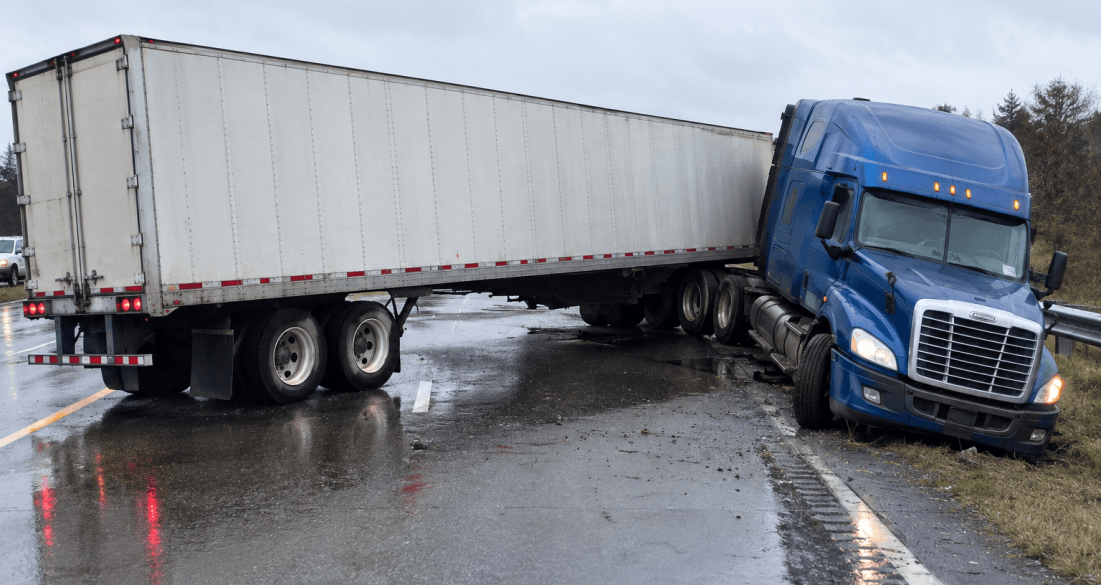
Jackknife, rollover, and underride are three distinct failures, not three words for the same thing. A jackknife is a loss of control between tractor and trailer, a rollover is a loss of lateral stability, and an underride is a smaller vehicle passing beneath a trailer rather than stopping against it. Each has its own mechanics, its own contributing conditions, and its own evidence trail, which is why identifying which one occurred shapes the whole investigation.
Louisiana’s weather and its long interstate stretches put the contributing conditions for all three in play. Rain reduces available friction, and sustained highway speed leaves less margin when something goes wrong.
At Lukov Injury Law, we start these claims by establishing which failure occurred, because that determines what to look for.
Each failure is set out below, with what contributes to it and where the proof sits. Contact us today to talk through what happened in your crash.
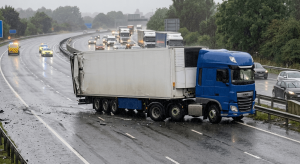 A jackknife occurs when the trailer loses traction and swings out of line with the tractor, folding toward it at the coupling.
The mechanics involve the difference in braking and traction between the two units. When the trailer’s wheels lose grip while the tractor’s retain it, or the reverse, the trailer can rotate around the coupling point rather than tracking behind.
Contributing conditions include:
The resulting geometry is what makes a jackknife dangerous to others. A trailer swinging across lanes occupies space that other traffic is already using.
Rollover is a lateral stability failure, and the physics differ from a jackknife entirely.
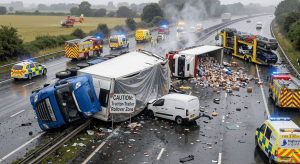 A tractor-trailer carries its mass high relative to its track width, which raises its center of gravity compared with a passenger car. Lateral force acts on that raised mass, and it comes from:
Load distribution matters here in a way it does not elsewhere. A load that shifts during transit moves the center of gravity while the vehicle is in motion, and a load secured improperly can shift under exactly the lateral forces a curve produces.
A ramp is where those forces concentrate, and that is a design feature of the road rather than a defect in it.
An underride occurs when a smaller vehicle travels beneath a trailer rather than striking it and stopping.
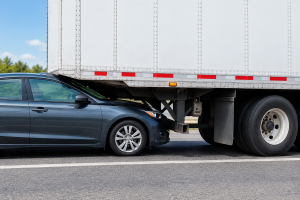 The consequence is a matter of geometry. A passenger vehicle’s safety systems, including its crumple structure and airbags, are designed around impact with something at roughly bumper height. A trailer bed sits higher, so the impact can bypass those systems and reach the passenger compartment directly.
Federal safety standards address this. Under 49 CFR 571.224, the stated purpose of the rear impact guard standard is to reduce deaths and serious injuries occurring when light-duty vehicles impact the rear of trailers and semitrailers, and it applies to trailers and semitrailers with a gross vehicle weight rating of 4,536 kilograms or more. The guards themselves are governed by 49 CFR 571.223.
Those standards address rear impact. Side underride is a different geometry and is not covered by the same rear guard requirement.
Louisiana’s geography puts freight traffic and difficult conditions in the same places.
The freight corridors carry sustained highway speeds over long distances, and speed is a factor in all three failure types:
Rain reduces the friction available between tire and road, which is a contributor to the traction loss behind a jackknife. A driver braking on a wet surface has less grip to work with, and the trailer’s grip and the tractor’s grip do not necessarily change at the same rate.
Elevated and bridge sections add crosswind exposure, and a rollover is exactly what lateral force on a high center of gravity produces. A stretch of raised roadway offers less shelter than a road at grade.
None of this makes a crash inevitable, and that is the point worth holding on to. Conditions that are known and predictable are conditions a professional driver is expected to adjust for, which is precisely why the fault question is worth examining rather than conceding.
The three failures point toward different evidence, which is why identifying the type early matters.
| Crash Type | What Establishes It | Where the Records Sit |
|---|---|---|
| Jackknife | Tire marks, resting positions of tractor and trailer, brake condition. | Maintenance records under 49 CFR 396.3, inspection reports under 396.11. |
| Rollover | Roll direction, load position after the event, curve or ramp geometry. | Load documentation, maintenance records, duty-status records under 395.8(k)(1). |
| Underride | Height of impact damage, condition and presence of the rear guard. | Vehicle inspection, periodic inspection documentation under 396.17. |
Fatigue can contribute to any of the three, which is why duty-status records matter across all of them. Those are retained not less than 6 months under 49 CFR 395.8(k)(1), while driver vehicle inspection reports run only 3 months under 396.11.
A written request does not by itself obligate a carrier in Louisiana to hold on to any of it, so the working protection is how quickly the question is raised.
The crash type shapes the fault argument, and in Louisiana the fault argument decides the recovery.
Under Civil Code article 2323 as amended by Act 15 of 2025, effective January 1, 2026, a person found 51 percent or more at fault recovers nothing, and a lower share reduces the award proportionally. Incidents before that date remain under the older pure comparative fault system.
Each crash type invites a different defense. A jackknife may be attributed to road conditions, a rollover to an evasive maneuver, and an underride to the following distance of the smaller vehicle. Physical evidence is what answers those arguments.
Louisiana sets a two-year prescriptive period for most personal injury claims from the day the injury is sustained, which is longer than every record retention floor above.
Which of the three failures occurred shapes everything that follows in a Louisiana 18-wheeler crash claim, from the scene evidence to the records requested.
Jackknife, rollover and underride each leave a different signature, and the records that explain them have short lives. At Lukov Injury Law, we identify the failure first and pursue the matching records before they expire.
Abby Lukov takes these calls herself from our New Orleans office, and the first conversation costs nothing. Call us today at 504-315-5056 to talk through your crash and what the evidence shows.
A jackknife occurs when the trailer loses traction and swings out of alignment with the tractor, folding toward it at the coupling point. It involves a difference in traction or braking between the two units, and contributing conditions include reduced surface friction, uneven or heavy braking, and speed relative to conditions.
A tractor-trailer carries its mass high relative to its track width, which places its center of gravity higher than a passenger car’s. Lateral force from a curve, ramp, evasive steering input or crosswind acts on that raised mass, and a load that shifts during transit moves the center of gravity while the vehicle is moving.
An underride occurs when a smaller vehicle travels beneath a trailer rather than striking it and stopping. A passenger vehicle’s crumple structure and airbags are designed around impact at roughly bumper height, and a trailer bed sits higher, so the impact can bypass those systems and reach the passenger compartment.
Federal safety standards address rear impact. Under 49 CFR 571.224, the standard’s stated purpose is to reduce deaths and serious injuries when light-duty vehicles impact the rear of trailers and semitrailers, and it applies to trailers and semitrailers with a gross vehicle weight rating of 4,536 kilograms or more. The guards themselves are governed by 49 CFR 571.223.
The rear impact guard standard addresses impact with the rear of a trailer. Side underride involves a different geometry and is not covered by the same rear guard requirement, which is a distinction worth raising early because it affects what the investigation looks for.
In a jackknife the traction picture changes with load. Less weight pressing the trailer’s tires to the road means less available traction, which affects how the trailer behaves under braking. Load also matters in rollover, where a shifting or improperly secured load moves the center of gravity while the vehicle is in motion.
Physical evidence at the scene carries part of it, including tire marks, the resting positions of the tractor and trailer, roll direction and load position. Records add the rest, with maintenance files under 49 CFR 396.3, inspection reports under 396.11 and duty-status records under 395.8(k)(1).
Driver vehicle inspection reports are retained for three months under 49 CFR 396.11, records of duty status not less than six months under 395.8(k)(1), and maintenance records for one year plus six months after the vehicle leaves the carrier under 396.3(c). Louisiana’s two-year prescriptive period runs longer than all of them.
Disclaimer: This article provides general information and should not be treated as legal advice. Laws change over time, and outcomes depend on the specific facts of each case. No attorney-client relationship is created by reading this article or contacting Lukov Injury Law LLC. For advice about your situation, contact a qualified attorney. Time limits apply to legal claims, so do not delay in seeking legal help.