Licensed in Louisiana, Texas, and Arkansas
Licensed in Louisiana, Texas, and Arkansas

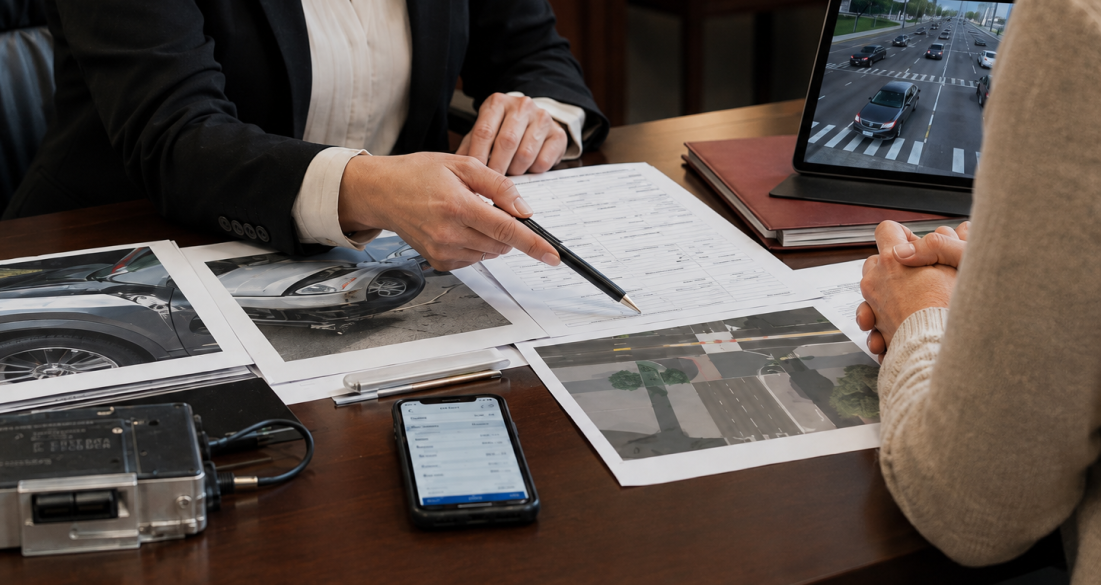
Distracted driving, impaired driving, speeding, and failure to yield rank among the most common causes of car wrecks on Louisiana roads. Preliminary 2024 data from the Louisiana Department of Transportation and Development recorded 180 distraction-related deaths and 1,295 serious injuries statewide. The cause of a crash matters beyond safety, because it shapes who is assigned fault, what evidence carries the claim, and how much a person can recover under Louisiana’s fault rules.
Every crash has a story behind it, and that story usually starts with a decision someone made in the seconds before impact. Understanding which decisions cause the most wrecks helps explain why some claims move quickly, and others stall.
Cause is not just a safety question in Louisiana, because it drives the fault split that decides what a claim is worth. At My Lawyer Abby, the personal injury practice of Lukov Injury Law LLC, we build car wreck claims around what actually caused the collision.
This guide walks through the leading causes on Louisiana roads and what each one takes to prove. Contact us today to talk through what caused your wreck and where your claim stands.
Distraction, impairment, speed, and failure to yield show up again and again in fatal and injury collisions. The Louisiana Highway Safety Commission runs dedicated distracted driving and impaired driving programs among its statewide safety program areas.
Distraction alone accounts for a large share of them. Preliminary 2024 data from the Louisiana Department of Transportation and Development recorded 180 deaths and 1,295 serious injuries in distraction-related crashes statewide.
Those categories overlap more than people assume. A driver running late may speed, check a phone, and roll a stop sign in the same trip, and a crash that follows can involve all three.
Each of these behaviors leaves a different evidence trail, which is what turns a bad decision into a provable claim.
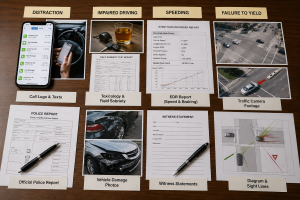 Phone use is the distraction people picture first, and it is the one that leaves the clearest record. Call logs, text timestamps, and app activity can place a driver’s attention somewhere other than the road.
Distraction covers more than phones, though. Eating, reaching for something, adjusting controls, and talking with passengers all pull attention away, and none of them leave a digital footprint.
That gap in evidence is why witness accounts and vehicle data matter so much in these cases. A driver who did not brake before impact tells a story that a phone record alone might miss.
Alcohol and drug impairment remains among the leading contributors to Louisiana traffic deaths. Impairment cases often come with a parallel criminal matter, which can produce test results, reports, and officer observations.
The criminal case does not decide the civil claim, but it shapes it. A conviction can support the fault argument, while an acquittal does not close the door on a civil case, because the standard of proof differs.
Louisiana limits claims against the bar or restaurant that served the drinks, treating the consumption rather than the serving as the cause of the injury. Narrow exceptions exist, including service to someone under 21, so that question is worth reviewing rather than assuming either way.
Speed changes both the odds of a crash and the severity of what follows. Tailgating, weaving between lanes, and running lights fall into the same behavioral group and often appear together.
Proving speed usually means reconstructing it rather than measuring it. Skid marks, crush damage, event data recorder readings, and traffic camera footage all help establish how fast a vehicle was traveling.
Commercial drivers add another evidence layer, because trucks carry electronic logging devices and telematics. We handle Louisiana 18-wheeler accident claims where that data becomes the center of the case.
Intersection crashes and rear-end collisions round out the list. Both come down to a driver who did not leave enough room, in space or in time.
Louisiana law sets a duty to keep a reasonable and prudent following distance, and a driver who strikes the vehicle ahead is presumed at fault under that rule. The presumption can be rebutted, but it starts the case on uneven footing for the following driver.
Failure-to-yield crashes are less predictable. Fault often turns on sight lines, signal timing, and who entered the intersection first, which makes early scene evidence valuable.
Some causes announce themselves at the scene, while others take work to establish. The table below shows what tends to prove each cause and what tends to undercut it.
The pattern is consistent: causes that leave data are easier to establish than causes that leave only competing stories.
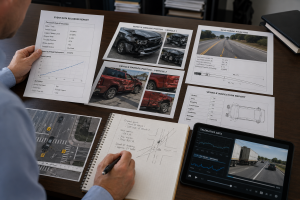 Louisiana ties recovery directly to fault percentages, so the cause of a crash carries a dollar value. For causes of action arising on or after January 1, 2026, a person found 51 percent or more at fault recovers nothing, and anything under that reduces the award proportionally.
That rule changed recently. Crashes before that date fall under Louisiana’s older pure comparative fault system, where a plaintiff could recover a reduced share regardless of how much fault they carried.
Insurers understand this math, which is why they work to attach a share of fault to the injured person. A claim built on documented cause, rather than a general account, is harder to shift.
Timing matters alongside cause, because Louisiana sets a two-year prescriptive period for most injury claims from the day the injury is sustained. Evidence that establishes cause, including vehicle data and camera footage, often disappears long before that deadline.
We handle Louisiana car wreck claims across every cause on this list, and the work starts with pinning down what happened. Riders face a harder version of the same problem, so we approach motorcycle injury claims with the fault argument in mind from day one.
The cause of your wreck is not a detail to sort out later, because it shapes what your claim can recover. At My Lawyer Abby, we investigate cause early, while the evidence that proves it still exists.
You work directly with Abby, not a case manager, and the first conversation costs nothing. Call us today to talk through what caused your crash and what the evidence shows.
Disclaimer: This article provides general information and should not be treated as legal advice. Laws change over time, and outcomes depend on the specific facts of each case. No attorney-client relationship is created by reading this article or contacting Lukov Injury Law LLC. For advice about your situation, contact a qualified attorney. Time limits apply to legal claims, so do not delay in seeking legal help.
Distracted driving ranks among the leading contributors to serious crashes in Louisiana. Preliminary 2024 data from the Louisiana Department of Transportation and Development recorded 180 deaths and 1,295 serious injuries in distraction-related crashes. Impaired driving, speeding, and failure to yield round out the top group of contributing factors statewide.
Phone records, text and app timestamps, and vehicle data showing no braking before impact are the strongest proof. Witness accounts and nearby camera footage fill gaps, which matters because non-phone distractions such as eating or reaching for an item leave no digital record at all.
No. A police report reflects an officer’s assessment based on what was available at the scene, and it can be useful evidence, but it does not bind an insurer or a court. Fault is decided on the full record, which often includes evidence gathered after the report was written.
Fault is divided by percentage. For claims arising on or after January 1, 2026, a person 51 percent or more at fault recovers nothing, and a lower share reduces the recovery proportionally. Someone found 30 percent at fault, for example, would recover 70 percent of their damages.
No, but the rear driver is presumed at fault based on the duty to keep a reasonable following distance. That presumption can be rebutted with evidence that the lead driver stopped without cause or that another vehicle pushed the rear car forward.
Louisiana sets a two-year prescriptive period for most personal injury claims, running from the day the injury is sustained. Injuries occurring before July 1, 2024 fall under the older one-year period. Deadlines vary by claim type, so an early review is worthwhile.
No. A conviction can support the fault argument in a civil claim, but the two proceedings are separate and use different standards of proof. A civil case still requires proof of causation and damages, and an acquittal does not prevent a civil claim from moving forward.
Surveillance and dash camera footage often overwrite within days or weeks. Vehicles get repaired or scrapped, taking crush damage and event data recorder information with them, and witness memories fade. Securing that evidence early matters, because a written request alone does not obligate someone else in Louisiana to hold on to it.