Licensed in Louisiana, Texas, and Arkansas
Licensed in Louisiana, Texas, and Arkansas

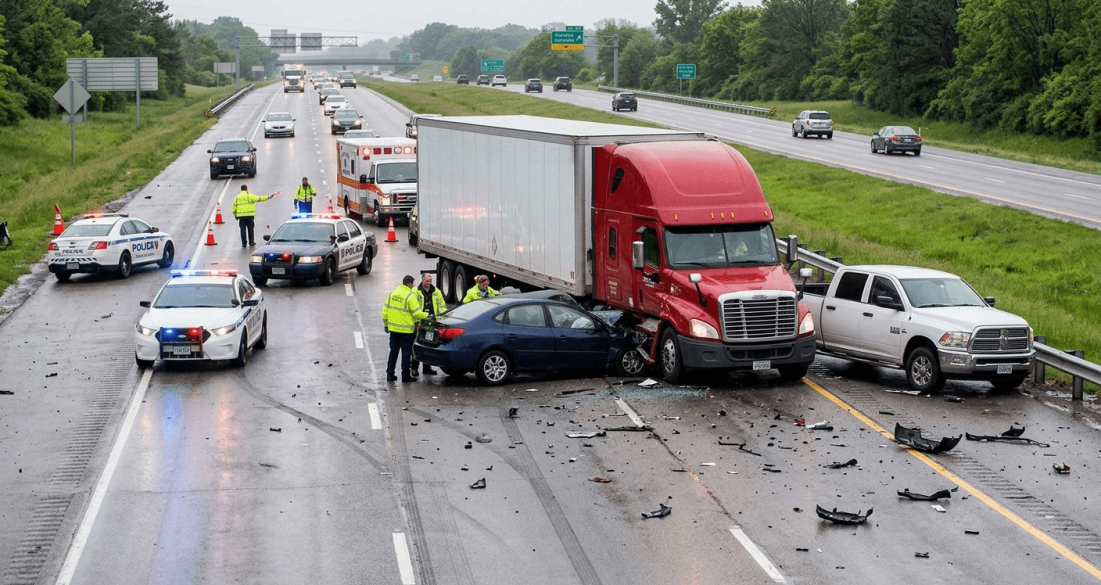
A Louisiana truck accident claim can run against the driver, against the motor carrier, or against both, and those are not the same claim. One route holds the company answerable for what the driver did. The other holds the company answerable for what the company itself did, and it rests on a different body of evidence.
Which route or routes apply depends on the employment relationship, on what the carrier’s own records show, and on the facts of the collision. Sorting this out early matters, because the records that support a claim against the company have short retention periods.
At Lukov Injury Law, we identify which routes are available before deciding how to build the claim.
Set out below are the two routes, the Louisiana rules that govern them, and one significant change to the law in 2024. Contact us today to talk through your situation.
 The first route is vicarious liability, which is a settled feature of Louisiana law.
Louisiana Civil Code article 2320 provides that masters and employers are answerable for the damage occasioned by their servants and overseers, in the exercise of the functions in which they are employed. Applied to trucking, an employer can be answerable for the fault of a driver acting within the scope of employment.
The important feature of this route is what it does not require. It does not require proof that the company itself did anything wrong. If the driver was at fault and was acting within the scope of employment, the employer’s answerability follows from the relationship.
The limit is in the phrase “in the exercise of the functions in which they are employed.” Conduct outside the scope of employment is a different question, and one that turns on facts rather than on labels.
The second route addresses the carrier’s own conduct rather than the driver’s.
Motor carriers operate under obligations imposed directly on them by the Federal Motor Carrier Safety Regulations. Under 49 CFR 396.3(a), every motor carrier “must systematically inspect, repair, and maintain, or cause to be systematically inspected, repaired, and maintained,” all motor vehicles subject to its control. That duty sits with the carrier, not the driver.
Duty-status regulation works the same way. The hours-of-service limits in 49 CFR 395.3 set:
Dispatch and scheduling decisions sit on the company side of that line.
A direct claim of this kind stands on its own footing. It does not depend on the driver being an employee in the vicarious liability sense, because it addresses what the company did rather than what the driver did.
Because the two routes draw on entirely different evidence.
| Dimension | Vicarious Liability Route | Direct Claim Against Carrier |
|---|---|---|
| Central question | Was the driver at fault, and within the scope of employment? | Did the carrier meet its own obligations? |
| Evidence source | Scene evidence, driver conduct, employment relationship. | Carrier records, maintenance files, dispatch and duty-status data. |
| Depends on employment status | ✓ Yes | ✕ No |
That second column is where record retention becomes decisive. Records of duty status and supporting documents are retained not less than 6 months from the date of receipt under 49 CFR 395.8(k)(1). Driver vehicle inspection reports are retained 3 months from the date prepared under 396.11. Maintenance records under 396.3(c) run 1 year, plus 6 months after the vehicle leaves the carrier’s control.
A written request does not by itself obligate a carrier in Louisiana to hold on to any of that, so the practical protection is how quickly the records are pursued.
 This is where the law changed, and where older guidance is now out of date.
Louisiana was long known for a broad direct action statute permitting an injured person to name the insurer directly. That is no longer the general rule. Act No. 275 of the 2024 Regular Session, effective August 1, 2024, amended La. R.S. 22:1269 so that an injured person has no right of direct action against the insurer unless a specified circumstance applies.
Those circumstances are narrow. They include matters such as:
The same Act repealed Louisiana Code of Evidence article 411(D).
Whether an exception applies is a question for the facts of a particular case. What has changed is the starting point, and anyone relying on the older understanding of Louisiana direct action should have it checked against the current statute.
Employment status can be contested, and the answer is not settled by what the paperwork calls someone.
A carrier may argue that a driver was an independent contractor rather than an employee, which speaks to the vicarious liability route. Courts look at the substance of the relationship rather than the label attached to it, and the analysis is fact-specific.
This is one of the practical reasons the direct claim route matters. Because it addresses the carrier’s own obligations under the federal regulations, it is not resolved by how the driver was classified.
The two routes can be pursued together for that reason, and the choice is a matter of what the facts and the records support.
Both routes run on the same clocks and the same fault arithmetic.
Louisiana sets a two-year prescriptive period for most personal injury claims under Civil Code article 3493.1, running from the day the injury is sustained, for injuries occurring on or after July 1, 2024. Earlier injuries fall under the previous one-year period.
Under Civil Code article 2323 as amended by Act 15 of 2025, effective January 1, 2026, a person found 51 percent or more at fault recovers nothing, and a lower share reduces the award proportionally. Incidents before that date remain under the older pure comparative fault system.
The two-year period is longer than every federal retention floor above, which is why the evidence timeline and the filing timeline should not be treated as the same thing.
Deciding which route or routes to pursue is the opening question in a Louisiana 18-wheeler crash claim, and it is answered by the records rather than by preference.
Naming the right parties is a decision that follows the evidence rather than preceding it, and the evidence that supports a claim against the company expires soonest. At Lukov Injury Law, we look at the relationship, the records, and the current version of the statute before deciding.
Abby Lukov decides who to name and explains the reasoning to you herself. The first conversation costs nothing. Call us today at 504-315-5056 to talk through your crash.
Louisiana law provides two routes. Under Civil Code article 2320, an employer can be answerable for the fault of a driver acting within the scope of employment. Separately, a claim can address the carrier’s own conduct under its federal obligations, such as vehicle maintenance and scheduling. Both may apply.
Vicarious liability makes the employer answerable for the driver’s fault without requiring proof that the company itself did anything wrong. A direct claim addresses what the company did, drawing on its maintenance, dispatch and duty-status records, and does not depend on how the driver was classified.
Not as a general rule any longer. Act No. 275 of the 2024 Regular Session, effective August 1, 2024, amended La. R.S. 22:1269 so that an injured person has no right of direct action against the insurer unless a specified circumstance applies, such as the insured’s bankruptcy or insolvency or unsuccessful service of citation.
It matters to the vicarious liability route, because that route depends on the employment relationship. It does not resolve a direct claim against the carrier, which addresses the company’s own obligations under the federal regulations. Classification is decided on the substance of the relationship rather than the label used.
Maintenance and inspection files under 49 CFR 396.3, driver vehicle inspection reports under 396.11, periodic inspection documentation under 396.17, and records of duty status with their supporting documents under 395.8(k)(1). Each has its own retention period, and the shortest is three months.
Driver vehicle inspection reports are retained three months from the date prepared under 49 CFR 396.11, records of duty status not less than six months from the date of receipt under 395.8(k)(1), and maintenance records one year plus six months after the vehicle leaves the carrier’s control under 396.3(c).
Louisiana reduces recovery by the fault percentage assigned. Under Civil Code article 2323 as amended by Act 15 of 2025, effective January 1, 2026, a person found 51 percent or more at fault recovers nothing, and a lower share reduces the award proportionally. Incidents before that date remain under the older pure comparative fault system.
Louisiana Civil Code article 3493.1 sets a two-year prescriptive period for most personal injury claims, running from the day the injury is sustained, for injuries occurring on or after July 1, 2024. Earlier injuries fall under the previous one-year period, so the date of the crash matters.
Disclaimer: This article provides general information and should not be treated as legal advice. Laws change over time, and outcomes depend on the specific facts of each case. No attorney-client relationship is created by reading this article or contacting Lukov Injury Law LLC. For advice about your situation, contact a qualified attorney. Time limits apply to legal claims, so do not delay in seeking legal help.